

Worker Retention Payment • Occupancy Strategy
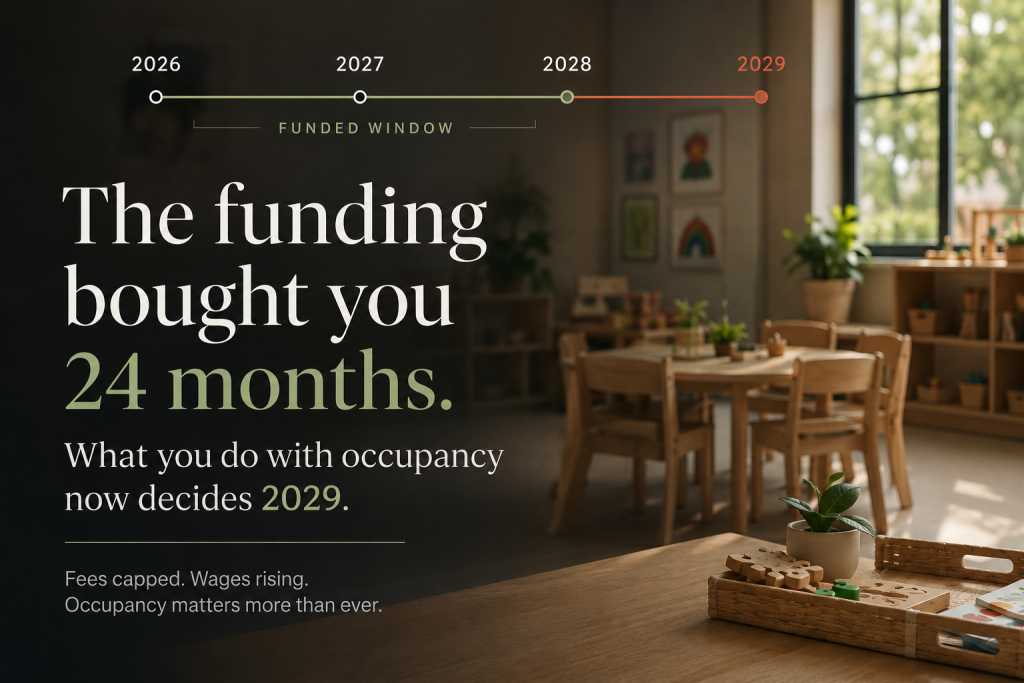
The funding bought you 24 months. Your occupancy decides what happens next.
The Worker Retention Payment extension gives operators valuable breathing room. It does not remove the long-term wage pressure. It gives you a window to strengthen the number that will matter most when the funding ends: occupancy.
It is confirmed. On 17 June 2026, the Australian Government announced a further $3.6 billion to extend the Worker Retention Payment through to 30 June 2028.[1]
After months of operators being unable to plan confidently beyond the previous program period, that is genuine relief.
But do not file it under “good news” and move on.
The extension gives the sector a funded window in which to stabilise its workforce and strengthen service performance. It does not make the underlying wage increase temporary. Award rates are already changing, and for some classifications the staged increases continue through to 30 June 2029.[4]
How full will your services be when the funding window closes?
What was actually announced
The government confirmed several important changes on 17 June 2026:
- The Worker Retention Payment will continue until 30 June 2028.
- The extension is backed by an additional $3.6 billion.
- Family Day Care and In Home Care services can become eligible where they engage their educators as employees and meet the relevant grant conditions.
- Fee-growth limits remain a condition of receiving the payment.
- From July 2027, services that are not rated Meeting in Quality Area 2 of the National Quality Standard may have funding cut or suspended.[1][3]
The payment continues to fund higher wages for eligible workers and related employment on-costs. However, the way the grant interacts with award rates changes as the Children’s Services Award rises.[6][7]
The important distinction
The Worker Retention Payment was introduced as a 10% wage increase from December 2024, rising to 15% from December 2025. As award rates increase, the amount that must be paid above the award reduces. The extension supports the required higher wage rates through to June 2028, but it does not stop those higher award obligations from becoming part of the sector’s permanent wage structure.
The funding runs to 2028. The wage transition extends beyond it.
This is the part many celebration posts miss.
The grant is a bridge. It is not yet a permanent funding commitment.
The Fair Work Commission found that Children’s Services Award rates had been affected by gender-based undervaluation and approved a new classification structure with staged increases. The first changes took effect from 1 March 2026. Further increases apply from 30 June in subsequent years.[4][5]
The timetable is not identical for every classification:
- For some classifications, the staged transition is completed by 30 June 2028.
- For others, including several educator levels and directors, a final stage is scheduled for 30 June 2029.[4]
That creates two dates operators need to watch:
- 30 June 2028: the currently announced Worker Retention Payment extension ends.
- 30 June 2029: the final scheduled award stage applies to some classifications.
Unless further government funding or a replacement mechanism is announced, operators should plan on the basis that wage obligations remaining after the grant ends will need to be carried by the business.
That is not a prediction that the government will walk away. It is the only responsible assumption available until another commitment is formally announced.
The fee cap creates a squeeze, but the exact 2027–28 settings are still to come
To receive the Worker Retention Payment, participating services must limit fee growth.
For existing participants, the published cap is currently 5.8% between 8 August 2026 and 7 August 2027. Services joining under the newer arrangements, including eligible Family Day Care and In Home Care services, are also subject to a 5.8% limit over the applicable published period.[1][3]
The government has said the fee-growth condition will continue under the extension. However, at the time of writing, the department has not yet published the specific cap that will apply after 7 August 2027.
That distinction matters. It would be inaccurate to say operators are already locked into a published two-year percentage. What is confirmed is that fee restraint remains part of the deal, and further settings are still to be released.
Services can request an alternative fee-growth cap in limited circumstances where financial viability is affected. The department requires evidence at both provider and service level, and approval is not automatic.[3]
The commercial reality
You may still be able to increase fees within the cap, and you may have other operational levers available. But you cannot assume pricing alone will absorb every increase in wages, rent, insurance, food, utilities, compliance and administration.
This is not merely a marketing question. It is a viability question.
Put the two halves together:
- Higher educator wages are becoming embedded in the award structure.
- The currently announced grant expires on 30 June 2028.
- Fee growth remains constrained as a condition of receiving the funding.
- Other operating costs are unlikely to stand still.
Occupancy is not the only lever available to an operator. Labour deployment, rostering, cost control, service mix, room configuration, debt management and pricing within the permitted cap all matter.
But occupancy is one of the most powerful levers because it increases revenue without requiring the service to duplicate every fixed cost.
Rent, leases, insurance, software, compliance systems, centre leadership and a significant portion of baseline staffing do not fall in direct proportion when a service is under-occupied.
A stronger occupancy position spreads those costs across more paying places. A weaker position asks fewer families to carry the same underlying cost base.
That is why the economic value of an additional enrolment is often greater than the daily fee alone. Once mandatory staffing and variable costs are covered, each additional occupied place can make a disproportionately important contribution to the service’s margin.
Brand, marketing and tour conversion still matter. They are how occupancy is created.
Occupancy does not drift upwards because a provider waits long enough.
It is the output of an enrolment system:
- The right local families become aware of the service.
- They understand why it is different from nearby alternatives.
- They enquire.
- The enquiry is followed up quickly and consistently.
- They book and attend a tour.
- The tour gives them enough confidence to choose the service.
- The family enrols for the rooms and days the service actually needs to fill.
Your brand matters because it shapes the choice. Your advertising matters because it creates demand. Your follow-up matters because enquiries decay quickly. Your tour process matters because interest does not automatically become an enrolment.
None of those activities is the final commercial outcome. Occupancy is.
The difference between 78% and 90% is not twelve percentage points on a report
It is twelve additional occupied places for every 100 licensed places, subject to room configuration, staffing ratios, attendance patterns and demand by day.
Across a year, that difference can represent thousands of additional booked days.
The exact financial value varies by:
- daily fee
- room and age mix
- staffing ratios
- days of attendance
- casual and agency labour use
- food and consumable costs
- CCS-related charging arrangements
- the amount of spare capacity that can be filled without adding another rostered employee
But the direction of the maths is straightforward: persistent vacancies leave revenue unused while a large portion of the service’s cost base continues.
Every quarter spent materially below achievable occupancy is a quarter of capacity that cannot be sold later. The funding deadline keeps moving closer whether the enrolment pipeline is healthy or not.
The operators who use this window will be stronger when it closes
The sector has been given a funded window through to 30 June 2028.
The weak response is to treat the extension as permission to postpone difficult commercial decisions.
The strong response is to use the window to:
- stabilise educator retention
- improve enquiry response times
- fix room-specific vacancies
- strengthen tour conversion
- build local market visibility
- reduce reliance on last-minute discounting
- improve the quality and predictability of the enrolment pipeline
- build a cash and occupancy buffer before the current funding period ends
The operators who reach 2028 with the same structural vacancies they have today may face the next wage transition with little room to move.
The operators who use the next two years to build sustainable demand will approach the same deadline with stronger revenue, more stable staffing and more options.
Your occupancy target needs to become specific
“We need more enrolments” is not a strategy.
A serious occupancy plan should answer:
- Which rooms are below target?
- Which days are hardest to fill?
- How many commencements are required each month?
- How many children will leave for school or relocate?
- How many enquiries are required to create those commencements?
- What percentage of enquiries currently book tours?
- What percentage of booked tours attend?
- What percentage of attended tours enrol?
- How quickly is each new enquiry contacted?
- Why do families choose the service down the road instead?
Without those numbers, occupancy remains a hope rather than a managed commercial outcome.
The Enrolment Boost position
At Enrolment Boost, occupancy is the whole game.
We work with one operator per suburb because serious enrolment growth requires a clear local competitive position. The goal is not to generate the cheapest clicks or the largest pile of low-intent leads.
The goal is to help the right local families see why your service is the right fit, move them from interest to tour, and turn that trust into occupied places.
Operators are not chosen because they appeared in a feed once. They are chosen because their marketing, follow-up, reputation and centre experience create confidence.
If your occupancy is not where it needs to be, this funding extension gives you time to fix it.
It does not give you a reason to wait.
Know where you stand before the window closes
If you want to understand the gap between your current occupancy and the position your service needs before June 2028, start with an honest assessment of your rooms, days, enquiry flow and conversion rates.
The best time to strengthen occupancy is while the workforce support is still in place, not after the cost structure changes.
Sources
- Australian Government Department of Education, “Worker retention payment extended to 30 June 2028”, 17 June 2026.
- Australian Government Department of Education, Worker Retention Payment overview and key dates.
- Australian Government Department of Education, Worker Retention Payment eligibility, fee-growth caps and conditions.
- Fair Work Commission, Gender-based undervaluation decision [2025] FWCFB 283, 10 December 2025.
- Fair Work Commission, “Minimum wage increases for children’s services employees”, 26 February 2026.
- Australian Government Department of Education, Worker Retention Payment: payments and how they work.
- Australian Government Department of Education, Workplace instruments, awards and supported bargaining.
This article provides general commercial information only. It is not legal, industrial relations, financial or accounting advice. Worker Retention Payment requirements and award obligations can change. Providers should confirm the current rules with the Department of Education, Fair Work Commission, Fair Work Ombudsman and their professional advisers.