
G8 Education Just Quietly Told the Childcare Sector Something Every Operator Needs to Hear
By Martin Niedenfuhr, Founder of Enrolment Boost
On 29 April 2026, G8 Education stood up at its annual general meeting in Brisbane and quietly delivered the most important childcare data point of the year.
Most of the coverage missed it. The headlines focused on the share price falling 30% on the day, and the announcement that around 40 centres would be suspended. Industry commentators framed it as a corporate story. A single operator under pressure, dealing with the fallout of a difficult period.
That framing missed what was actually significant.
Buried in the trading update was a single number, and a single sentence from the CEO, that together told the entire Australian childcare sector something every operator needs to sit with. Not because G8 was admitting failure. But because of who G8 is, and what it means when an operator at that scale reports the data they reported.
G8 is, by some distance, the largest publicly-reported childcare data set in Australia. Almost 400 centres. 8,800 educators. 36,000 children attending each week. Brands across the spectrum from premium to mid-market, including Headstart, Creative Garden, Jellybeans, Kool Kids and World of Learning. When G8 reports occupancy data, it is not telling us about G8. It is giving us the most reliable, broadly-distributed, market-tested read on what is actually happening across the sector.
And what they reported on Wednesday is significant for every operator in the country, regardless of size.
This piece is an attempt to read those numbers properly, separate the cyclical from the structural, and identify what the data is really telling independent operators about where the market is heading.
The numbers worth sitting with
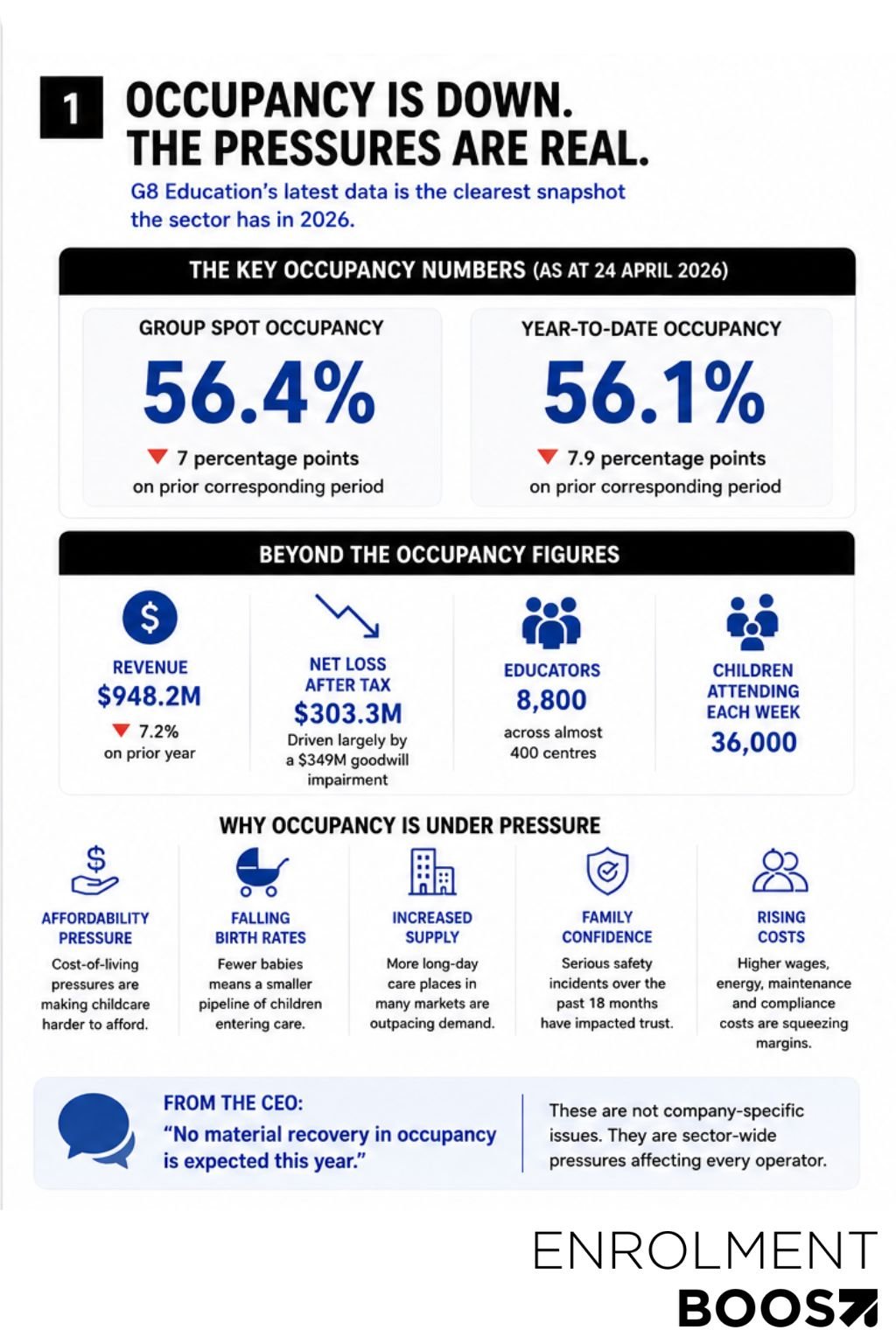
G8 reported that group spot occupancy as of 24 April 2026 was 56.4%, down 7 percentage points on the prior corresponding period. Year-to-date occupancy was 56.1%, down 7.9%. The CEO stated that no material recovery in occupancy is expected this year.
Underneath those headline figures sit a few additional data points worth noting. Full-year revenue came in at $948.2 million, down 7.2%. Statutory net loss after tax reached $303.3 million, driven largely by a $349 million goodwill impairment, an accounting recognition that the long-term value of acquired centres is now lower than it was assumed to be. The board paid no final dividend.
The factors G8 named as drivers of the slowdown are also worth taking seriously, because they are sector-wide rather than company-specific. Sustained affordability pressure on Australian families. Falling birth rates. Increased long-day care supply in many markets. Family confidence impacted by serious safety incidents in the sector over the past eighteen months. Rising wages following Fair Work Commission decisions. Higher energy and maintenance costs. Heavier compliance burden.
These pressures are real. They are affecting every operator in some combination, and any read of the sector that pretends otherwise is not paying attention to the data.
But the more important question is this. What do those macro pressures actually mean on the ground? Because while the macro is sector-wide, occupancy outcomes are not. Some centres are struggling. Others, often a few streets away, are running waitlists. The averages hide the dispersion, and the dispersion is where the real story is.
The cyclical and the structural
When a sector reports compressed numbers, there are usually two things going on simultaneously. Cyclical pressure that will normalise, and structural change that will not.
The cyclical components in this case are familiar. Cost-of-living pressure on Australian households is real but unlikely to remain at current levels indefinitely. Wage growth in early childhood education has run hard but will plateau. Energy costs will eventually stabilise. These forces are squeezing margins right now, but they are recoverable as macro conditions ease.
The structural components are different, and they are the ones operators need to be paying close attention to.
Three structural shifts are visible in the G8 data, and they apply to the entire sector.
The first is demographic. Australia’s birth rate has been declining for several years and the pipeline of children entering long-day care is genuinely smaller than it was in 2020. This is not a cycle. It is a slow-moving demographic reality that means total addressable demand will be lower for the rest of this decade than operators planned for during the boom years. Centres planned and built on 2018-2022 demand assumptions are now competing for a smaller pool of children.
The second is supply-side. Long-day care capacity expanded significantly through the boom period, with new builds approved on demand projections that have not materialised. The sector now has more places than the current cohort of children needs, and that imbalance is what is driving occupancy compression at the network level. This will resolve over time as underperforming centres exit, but the resolution is what we are watching unfold right now. Wednesday’s announcement is one visible piece of it.
The third, and the most important, is parent behaviour. This is the shift that does not get enough attention in the sector commentary, and it is the one that explains the gap between operators with similar fundamentals.
The parent shift
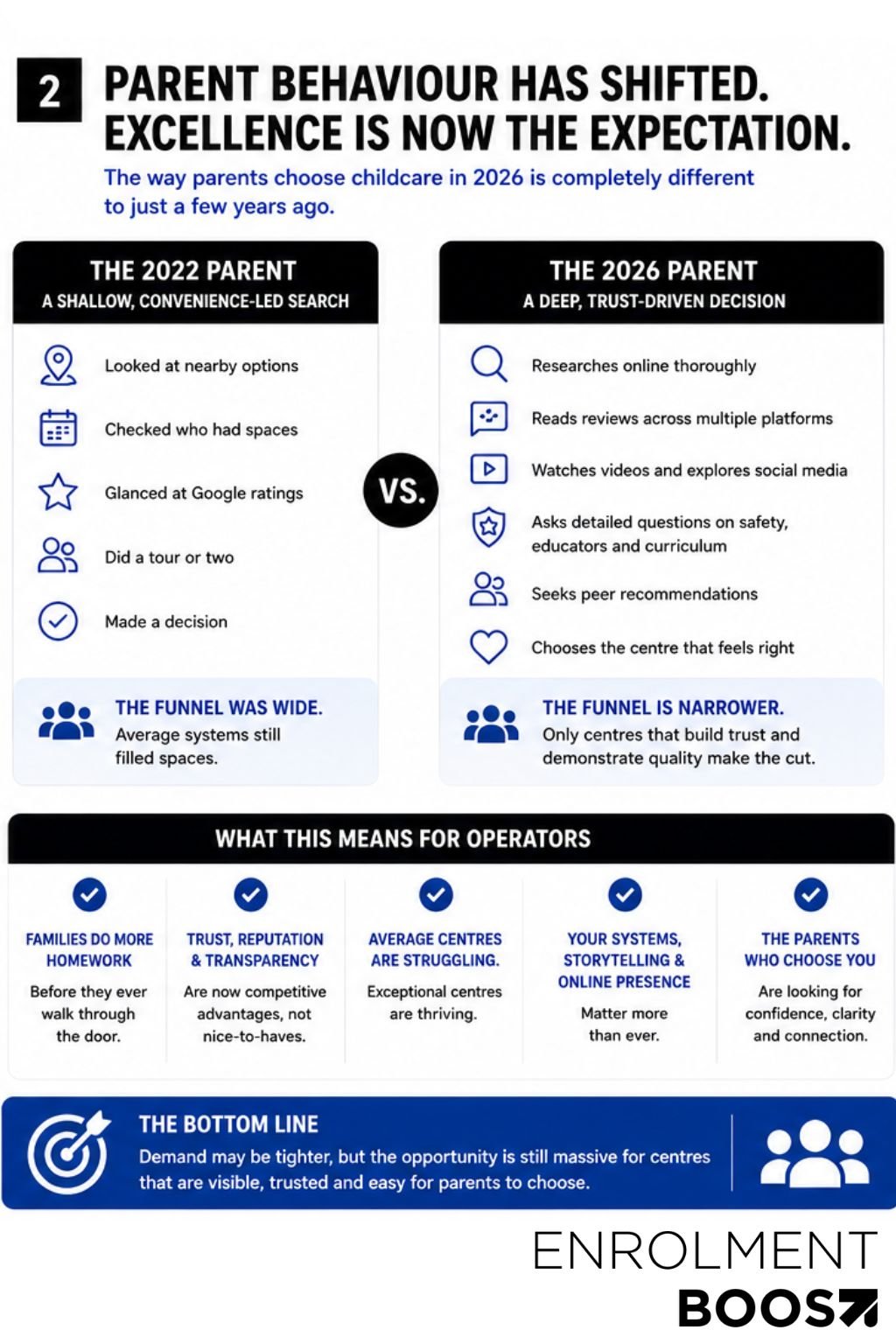
The parent searching for childcare in 2026 is making a meaningfully different decision than the parent who searched in 2022.
A few years ago, the shopping process was relatively shallow. A parent identified geographically convenient options, checked which had spaces, glanced at Google ratings, did a tour or two, and decided. The funnel was wide and parental due diligence was relatively light. Operators with average systems still filled spots because demand was strong and parents were not being especially selective.
Today, that same parent is doing something different. They are reading individual reviews carefully, not just the star count. They are noting how the centre responds to negative feedback. They are searching for individual educators by name to see how long they have been there. They are reading “About Us” pages with a level of attention that would have surprised any operator a decade ago. They are running a quiet, often subconscious assessment underneath all of it. How do I know my child is actually safe here.
The safety question is doing more work in parental decision-making right now than any other factor. The sector incidents of the past eighteen months, including those at G8 centres, have changed how families approach the choice, even families who would never raise the question explicitly. The result is that parents who would have enrolled within two weeks of starting their search are now taking six, eight, twelve weeks. They are touring more centres. They are asking more questions. They are slower to commit and quicker to walk away from anything that does not fully reassure them.
This shift compounds with the demographic and supply-side pressures to create a single underlying dynamic. The funnel has narrowed for everyone, and within that narrowed funnel, parents are being more selective.
Why the dispersion is so large
This is where the data becomes genuinely useful for individual operators.
The 56% sector-level number is an average. Underneath that average, occupancy outcomes are wildly bimodal. In the same suburbs where some centres are at 50%, others are at 85% with waitlists. The gap is not explained by location, by quality of physical centre, or by marketing budget. It is explained by how well each centre’s systems match the new parent buying behaviour.
The centres that are full in 2026 share three operational characteristics, and the centres that are not full are usually missing all three.
They are visible at the moment of intent. When a parent in their suburb opens Google Maps and types “childcare near me,” they appear in the top three local results. They have invested in their Google Business Profile. They have accumulated 50 or more genuine reviews with an average above 4.7. They are findable by AI search tools as well as traditional search. The first filter parents apply is whoever appears first, and operators with weak local visibility are filtered out before they ever get a chance to compete on quality.
They respond at the speed of intent. When a parent submits a website enquiry at 9pm after putting their kids to bed, they receive an automated, personal-feeling acknowledgement within 60 seconds. The next morning, a real human calls them back inside five minutes of the centre opening. Industry data on lead response is unforgiving. Contact rate at five minutes is roughly nine times higher than at thirty minutes. Operators who route enquiries to inboxes that get checked the next day are losing parents to whoever responds faster, regardless of how good the slow-responding centre actually is.
They have a system for staying present across the longer decision window. Most parents in 2026 need somewhere between three and seven touchpoints between tour and enrolment, and the gap between first interest and final decision now stretches to eight or twelve weeks. The centre that has built a system for staying in front of parents across that window wins them. The centre that finishes a tour, says “let me know what you decide,” and waits for a phone call that does not come, loses them.
The role of Meta, specifically
This last point deserves its own discussion, because it is the part of the operating system that almost every independent operator gets wrong.
The lengthening of the parent decision window is the single most consequential change in childcare marketing in the last five years. It changes which channels work, which channels do not, and how each channel needs to be deployed.
Google search ads remain essential because they capture parents at the moment they type a high-intent query like “childcare near me” or “childcare [suburb] enrolment.” That is the bottom of the funnel. Parents at that point are days away from enrolling somewhere, and the centre that shows up first and responds fastest usually wins them. But Google captures only the last fraction of the parent’s journey. By the time the parent searches that specific query, they have already shortlisted in their head.
Word of mouth and reviews remain powerful, but uncontrollable. You can build the conditions for them but you cannot turn them up or down on demand.
Boosted Facebook posts, which most centres treat as their entire social marketing strategy, are largely useless. They reach the centre’s existing followers once, mostly people who are already enrolled or already aware, and disappear. They do almost nothing for new enrolment.
Meta ads, run properly, are different. They are the only channel that allows an independent centre to stay present across the entire eight-to-twelve-week parent decision window without burning a corporate budget.
Run properly means a few specific things.
It means refreshing creative monthly so the audience does not develop ad fatigue. The same image and headline running for four months is invisible by week three.
It means running different messages for cold audiences (parents who do not know you yet, where the goal is awareness and trust) and warm audiences (parents who have visited the website, watched a video, engaged with previous content, where the goal is moving them toward a tour booking).
It means retargeting. The parent who visited your website on Tuesday but did not enquire is the highest-value advertising target you have. Most independents are not retargeting them at all. Their attention dissipates within days, and a competitor who is retargeting picks them up.
It means creative that addresses the specific things parents are now scoring you on. Educators by name. Photos and short video that convey continuity, warmth, and safety. The centre director on camera. The director’s specific philosophy. Real children doing real things. Generic stock-photo creative reads as corporate, and corporate is exactly what parents are increasingly trying to avoid.
It means tracking the right metrics. Cost per booked tour, not cost per click. Cost per enrolment, not cost per impression. Most centres running Meta ads are tracking vanity metrics that look fine on a dashboard but tell you nothing about whether the spend is producing actual enrolments.
Done properly, Meta becomes a quiet, compounding presence in the lives of every parent in your suburb who has shown any signal of being in market. Done badly, it is a slow leak of money for nothing.
The reason this matters in the context of G8’s data is straightforward. The parent decision window has lengthened. The funnel has narrowed. Word of mouth alone will not fill a centre in 2026 the way it did in 2020. The operators who build a presence across the entire decision window are the ones whose occupancy holds up. The operators who do not are the ones quietly losing enrolments to whichever centre stayed in front of the parent longest.
Independent operators have a real advantage here that gets overlooked. A small, owner-operated centre making decisions in days can refresh creative, test new angles, and respond to what is working in a way that a national operator routing decisions through a marketing department genuinely cannot. The cycle time on a corporate ad campaign is months. The cycle time on a well-run independent centre’s ads can be weekly. That speed of iteration, applied across an eight-week decision window, is how a centre with a fraction of the budget outperforms a centre with ten times the spend.
A 60-second self-diagnostic
If you operate or own a centre and want a quick read on where you sit relative to what the data says is happening, four honest answers will tell you most of what you need to know.
Where do you sit on local visibility? Pick up a phone right now, switch to incognito, and search “childcare [your suburb].” Are you in the top three Google Maps results? Do you have 50 or more reviews with an average above 4.5? If the answer to either is no, your visibility layer is leaking before you even get a chance to compete.
How fast do you respond? Look at the last ten enquiries that came through your website or phone. From submission to first real human contact, what was the median time? Under five minutes during business hours is winning. Anything over thirty minutes and you are losing parents to faster competitors regardless of how good your centre is.
What is your Meta presence actually doing? Look at your ad account from the last 90 days. How many different creatives have you run? Are you running separate campaigns for cold and warm audiences? Are you retargeting website visitors? If the honest answers are “one or two creatives, single campaign, no retargeting,” your Meta is decoration rather than a system, and you are leaving most of your potential reach across the parent decision window unused.
What happens after the tour? Map it out, step by step, for the fourteen days after a parent finishes a tour and walks out. What messages do they receive? On what cadence? From whom? If the honest answer is “nothing, or whatever the director remembers to send,” that is almost certainly your single largest source of lost enrolments.
If all four answers are strong, your occupancy is probably holding up well and any pressure you are feeling is genuinely macro. If two or more are weak, the macro is not the reason your numbers look the way they do. Your operating system is, and the macro is just exposing it.
What G8’s announcement actually means for the sector
What G8 reported on Wednesday is not, on a careful read, a story of crisis. It is a public, ASX-disclosed signal that the way Australian families choose childcare has shifted permanently, and that operators of any size who do not adapt their systems to match the new parent buying behaviour will continue to see compressed occupancy regardless of how the macro evolves from here.
For independent operators specifically, the data should be read as carefully optimistic. The structural advantages that independents have, including continuity of educators, named faces, deep community embeddedness, speed of response, and the ability to genuinely know each family, are exactly the things parents in 2026 are now looking for and prioritising. These advantages have always existed. What has changed is that they are now load-bearing. They matter to parents in a way they did not matter five years ago.
But they do not convert into enrolments by themselves. They convert when paired with operational system. Visibility at the moment of intent. Response at the speed of intent. A Meta presence built around the new, longer parent decision window. A follow-up architecture that matches the new parent decision timeline.
The centres that build those systems in the next 90 days will be the ones still telling a positive occupancy story when the next set of sector data comes out. The centres that wait for the macro to rescue them will be reading another version of Wednesday’s headlines, with a different name attached, in six months.
The data is doing the work. The question is what each operator does with it.
Martin Niedenfuhr is the founder of Enrolment Boost, an Australian childcare marketing agency that works exclusively with independent operators on a one-centre-per-suburb exclusivity model.